
- fanieboattours

- May 8
- 4 min read
Some trips fade from memory after a few weeks. Others stay with you long after you return home.The three days I spent on Weta Molas – Fanieboattours in Komodo National Park definitely belong to the second kind.
Our 3 days on a live aboard started in Labuan Bajo. The harbor was busy, loud, chaotic, and full of life. Fishing boats, speedboats, people everywhere — and in the middle of it all, our liveaboard waiting to take us into Komodo National Park. Once we left the harbor behind, everything changed. The sea opened up, the islands became greener, and the feeling of everyday life slowly disappeared.
Our first dive at Sebayur immediately showed why divers from all over the world come to Komodo. The reef was full of life. Schools of yellow-striped snappers moved through the blue while tiny nudibranchs hid between colorful corals. One of my favorite moments was seeing a giant pufferfish lying peacefully on the reef while small cleaner shrimps worked on him without interruption. Sea turtles appeared regularly during the dive, calm and completely unbothered by our presence.

At Tatawa Besar, I truly understood why Komodo is considered one of the best diving destinations in the world. The drift dive was relaxed, not too strong, allowing us to simply enjoy the reef and all its details. Healthy coral covered everything in bright colors. A blacktip reef shark passed by for only a few seconds before disappearing into the deep blue.
Manta Point was, of course, one of the highlights of the Komodo live aboard.
Even before entering the water, there was excitement on the boat. The dive site itself is massive and perfect for drift diving. First, we encountered an eagle ray slowly searching for food, completely undisturbed by divers nearby. Then came the moment everyone hopes for — a completely black manta ray gliding slowly above the cleaning station while butterflyfish removed parasites from its body.
Watching manta rays underwater feels almost unreal. Everything becomes quiet for a moment.

Gleichzeitig hat mich dort auch etwas nachdenklich gemacht. Man merkt inzwischen deutlich, wie viele Schnellboote täglich unterwegs sind. Manche Mantas tragen sichtbare Verletzungen. Natürlich stammen nicht alle von Booten, aber man fragt sich schon, wie lange dieser Ort die steigende Zahl an Besuchern noch verkraftet. Die Mantas wirken teilweise deutlich vorsichtiger als früher.
At the same time, Manta Point also made me think about how tourism is changing Komodo. There are more and more fast boats crossing the area every day, and some mantas showed visible injuries. Not all of them come from boats, of course, but the increasing traffic is impossible to ignore. The mantas already seem more cautious than they probably were years ago.
Another beautiful manta site was Mawan. Timing is important there because the area can become crowded with snorkelers and dive groups. And sometimes, despite waiting and hoping, no mantas appear at all. That’s nature — and honestly, that’s part of what makes these encounters special.


For me, Tatawa Kecil and Batu Bolong were absolute highlights of the trip. Grey reef sharks cruised along the reef while a whitetip reef shark rested quietly on the bottom. A huge sea turtle slowly moved through the current, completely relaxed around us. One giant moray eel had squeezed itself into a hole far too small for its body, curling around itself like a snake.


Massive schools of trevallies circled endlessly around the reef while smaller fish constantly stayed alert, trying not to become prey.
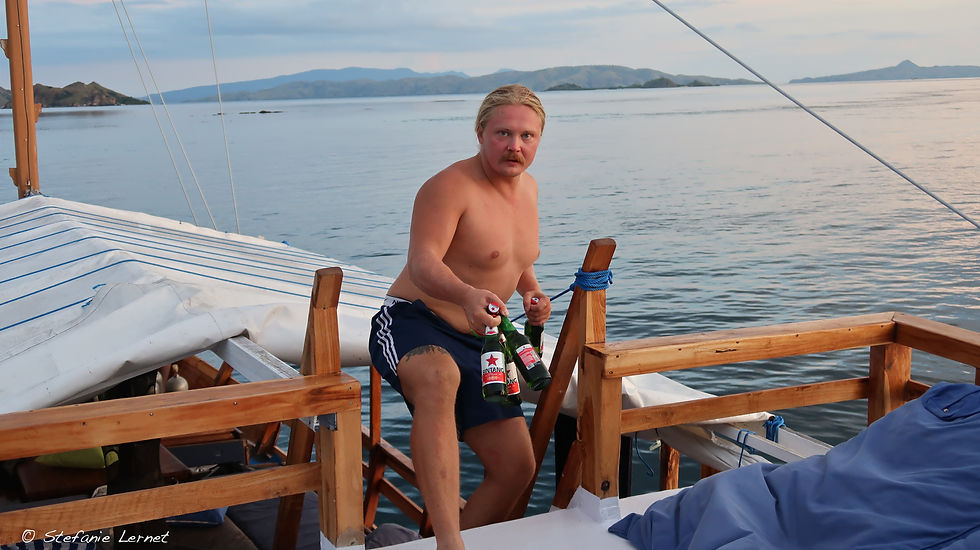
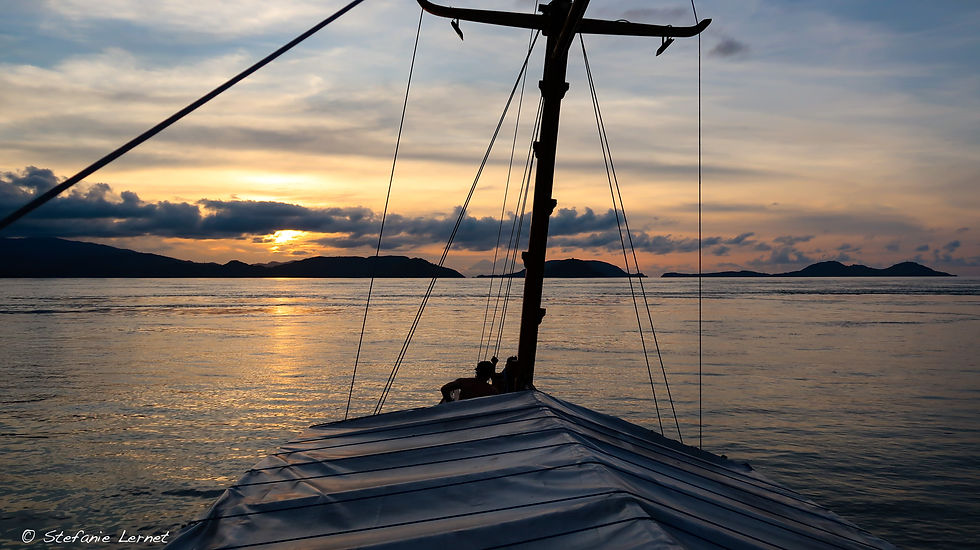
But what truly made the experience special was life on the boat between dives.
Relaxing on the shaded deck after a dive, watching the islands pass by, or having a cold beer during sunset became part of the rhythm of the trip. And those sunsets in Komodo… sometimes the colors looked almost unreal.
The food onboard was amazing like always. Fresh sourdough bread in the morning, nasi goreng for breakfast if you wanted, local dishes for lunch and dinner, and homemade sambals for anyone who enjoys spicy food.
Our cook, Son, personally bought fresh ingredients at the local market. You could feel how much effort and care went into every meal.
One of the most unforgettable dives was the night dive in Siaba. Night diving always feels like entering another world. In the narrow beam of our dive lights, completely different creatures appeared. Two scorpionfish used our light to hunt, tiny shrimps and crabs covered the reef, and for a brief moment, a small blue-ring octopus revealed itself between the rocks before disappearing again.

The three days passed incredibly fast.
On the final day, we visited Rinca Island to see the famous Komodo dragons. Together with a ranger, we walked through the dry landscape while learning more about the island’s wildlife and ecosystem. Most dragons were lying lazily in the shade, allowing plenty of time for photos, but there was still something intimidating about standing so close to these prehistoric animals.
One important thing to know: closed shoes are required for trekking on Rinca and Komodo Island — flip-flops are not allowed. Visitors also need to pay an additional entrance and ranger fee in cash.
By the time we returned to Labuan Bajo around 5 PM on the final day, it honestly felt like we had been away much longer than just three days.
Maybe because Komodo is not only about diving. It’s about the atmosphere, the wild nature, the remote islands, the sunsets, and those quiet moments in between.
And probably that’s exactly why so many people return.


Comments