

My first dives were in Austrian lakes. Visibility was often poor, and the underwater world rather limited. When I then dived in tropical waters for the first time, it was a completely new world. But I hadn't expected what awaited me on my first dive near Labuan Bajo in Indonesia.
Suddenly, a giant manta ray appeared from the blue. It glided silently overhead, elegant and seemingly effortless. In that moment, I knew that these creatures would be a part of my life for a long time to come.

Manta Rays – An Encounter Every Diver Dreams Of
Manta rays are among the largest fish in the world. With wingspans of up to seven meters, they appear almost unreal underwater. Yet, they exude an incredible tranquility. While other marine creatures frantically race through the reef, mantas glide serenely through the current, seemingly oblivious to all the hustle and bustle of the world.
Perhaps it is precisely this combination of size and serenity that captivates so many divers.
Every manta ray has its own personality.
Over time, I was fortunate enough to encounter many manta rays while diving in Komodo, where both reef mantas and the larger pelagic mantas can be found.
I repeatedly noticed that the animals reacted very differently. Some glide stoically along, unimpressed by divers or cameras. Others are considerably more curious.
I particularly remember one young manta ray. During a dive, I encountered a manta that approached on its belly and startled us a little by flicking its belly in our direction. Then it circled around a bit, came back, and seemed to enjoy our astonished faces.
Of course, no one truly knows what goes on inside a manta ray's head. But such encounters illustrate why many divers perceive these animals as exceptionally intelligent.
The last truly extraordinary experience I had was on a tour to the northern part of the park. Some guests had photographed an albino manta ray from a vantage point. When they showed me the pictures, I had to do a double take. A huge, entirely white albino manta ray was gliding through the water.
You spend many years diving with manta rays, you think you've seen almost everything – and then suddenly an albino appears. It's precisely moments like these that make this profession and every dive so special. Nature always manages to surprise you.
schwarzer Mantarochen Manta von unten gegen Meeresoberfläche, darunter schwimmt ein Thunfisch Manta von unten, blaues Meer
However, there are also completely black specimens. All manta rays have their own unique pattern on their bellies, by which they can be identified, similar to our fingerprints.
Underwater Wellness Appointment
Among the most fascinating places for manta rays are the so-called cleaning stations. There, the animals allow small cleaner fish to rid them of parasites and dead skin.
During a dive at Manta Point Komodo, I spent almost half an hour observing a large, pregnant female at one such station. She hovered patiently above the reef while the cleaner fish went about their work. I secretly hoped for a spectacular sighting, as the animal seemed as if the birth of her pup might be imminent.
But, as is so often the case in nature, everything unfolded according to the manta ray's own rules. Once the cleaning was apparently complete, she slowly disappeared into the blue, leaving me with many photos—but without the hoped-for sensation.
Manta von der Seite über Riff mit vielen kleinen Fischen Ein trächtiger Riesenmanta von hinten unten ein Stück Riff mit kaputten Korallen
The pregnant female manta ray - you can clearly see where the young animal is curled up, waiting for its birth.
The Dark Side of Tourism
As fascinating as manta rays are, the challenges they face are becoming increasingly apparent.
In recent years, I've noticed that encounters are becoming less frequent. It's particularly striking how sensitive many of these animals are to fast-moving tour boats. They often disappear before divers even enter the water.
Added to this are injuries caused by boat propellers, plastic waste, and fishing. Many manta rays bear visible scars. Careless divers and snorkelers can also stress the animals by getting too close or following them.
Why Manta Rays Deserve Our Protection
Manta rays have a very low reproductive rate. A female typically gives birth to only one offspring every two to three years. At the same time, they are threatened by fishing, bycatch, pollution, and climate change.
This is precisely why responsible tourism is so important. Anyone who encounters manta rays should keep their distance, not touch the animals, and always give them the opportunity to decide for themselves whether or not to interact.
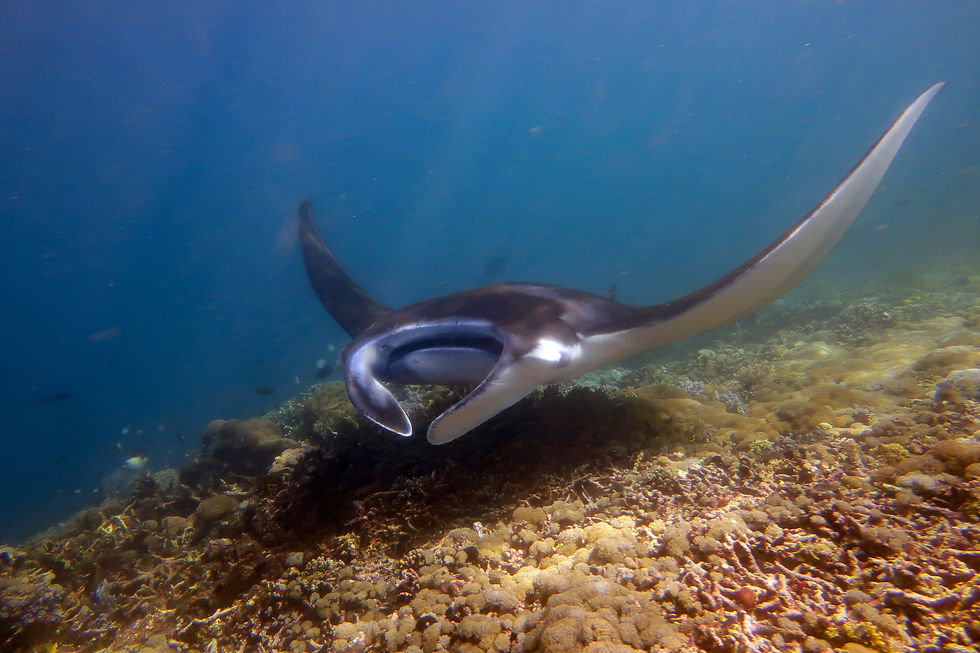
With patience and quiet, you can get very close to plant-eating manta rays while snorkeling. Their mouths and gills are wide open to filter clumps and tiny organisms from the water.
Conclusion
Even after countless encounters, my breath still catches in my throat when a manta ray emerges from the depths. Perhaps it's their size, perhaps their elegance, or perhaps the fact that they appear so peaceful despite their power.
For me, manta rays are among the most impressive animals in the oceans. And every time they glide silently overhead, I'm reminded why protecting these extraordinary marine creatures is so important.

A recommended website about manta rays: https://mantawatch.com
Here you can also sign a petition to protect manta rays in Indonesia, and you'll find more detailed information and photos on the topic. I'd also like to include the code of conduct for manta ray encounters created by MANTAWATCH.:
LISTEN – Listen carefully to your guide’s briefing. This will help you minimize the impact on nature, ensure your safety and enjoy a longer and more spectacular experience.
WATCH - the spectacle and enjoy it. For an optimal encounter, you should maintain a distance of at least 3 meters and give the manta ray time to come closer on its own. Please do not touch or ride manta rays as this can remove the protective mucous membrane and cause injury.
WAIT – Do not restrict the manta ray's movement or behavior. Approach the manta ray slowly. Do not hunt manta rays; Longer and more intense encounters usually result from waiting patiently and allowing the manta ray to approach you.
MOVEMENT – Divers should stay on or near the ocean floor covered in debris, sand or boulders. Manta rays require an open column of water to maneuver and will approach if you give them enough space. Form a semicircle with your group to give the manta ray a clear escape route.
BREATHE – Be aware that exhaled air bubbles may spook manta rays swimming above you.
THINK - Be mindful of your buoyancy, avoid accidentally hitting or damaging coral, and avoid touching the reef unnecessarily. Don't take anything from the underwater world with you.
PHOTOGRAPHERS – When taking photos and filming, please follow these rules and be considerate of other divers to get a good picture. Avoid excessive flashing. For the best shots, let the manta ray approach you.

